Friday, May 5, 2023

NRC-podcast "De volgende Einstein kan een computer zijn"

In de NRC Podcast 'Onbehaarde Apen' sprak ik op 15 februari 2023 over de laatste ontwikkelingen in de kunstmatige intelligentie. 

Klik op de afbeelding om naar de podcast te gaan.


Computers kunnen dankzij kunstmatige intelligentie boeken schrijven, schilderen, de allerbeste schaker ter wereld verslaan. Ze kunnen zebrastrepen herkennen en medische diagnoses stellen. Maar ze kunnen ook een heleboel niet, zoals menselijke intuïtie nabootsen. Daarbij gaan ze ook weleens de mist in. Zo zei de nieuwe chatbot van Google, Bard, dat de James Webb-telescoop als eerste foto's van een planeet buiten ons zonnestelsel had genomen. En ChatGPT deed per abuis verslag van een sportwedstrijd die nog helemaal niet had plaatsgevonden. Waar liggen de grenzen van AI? En: is de Einstein van de toekomst een computer?


Is de volgende Einstein een computer?

In 2022 bleken AI-systemen verbluffende schrijvers en schilders. AI-programma AlphaFold loste een decennia oud fundamenteel biologisch probleem op. Wanneer gaat AI zelf een wetenschappelijke ontdekking doen en deze glashelder en geduldig uitleggen aan menselijke wetenschappers?


Dit artikel is gepubliceerd in NRC Handelsblad van 25 februari 2023

Toen de Oostenrijkse natuurkundige Mario Krenn in 2016 promotieonderzoek deed bij een van de bekendste kwantumfysici ter wereld, Anton Zeilinger (Nobelprijswinnaar natuurkunde in 2022), wilden ze bepaalde nieuwe kwantummechanische toestanden in het laboratorium creëren. Maar wat ze ook probeerden, ze konden geen geschikte methoden verzinnen. Ze trokken de conclusie dat hun intuïtie hen in de weg zat, juist omdat de kwantummechanica zelf vol zit met tegenintuïtieve fenomenen. Licht dat zich de ene keer gedraagt als een golf en de andere keer als een deeltje; of deeltjes die op afstand toch met elkaar verstrengeld zijn ⎼ dat soort onbegrijpelijke dingen.

Als de menselijke intuïtie faalt, dan is het misschien beter om een computer, die weliswaar niet de voordelen maar ook niet de nadelen heeft van die intuïtie, naar oplossingen te laten zoeken, bedacht Krenn. Hij schreef een kunstmatig intelligent computerprogramma, Melvin genaamd, trainde het eerst op eenvoudigere kwantumsystemen en liet het vervolgens complexere experimentele opzetten voorstellen. Al snel genereerde Melvin een volkomen tegenintuïtief idee, dat menselijke natuurkundigen niet zouden bedenken, maar een paar jaar later wel echt bleek te werken in het laboratorium.

“We wisten Melvins oplossing te generaliseren tot een algemeen concept voor een nieuw type kwantummechanische verstrengeling”, vertelt Krenn in een interview. “We publiceerden de resultaten in Physical Review Letters, maar het interessante was dat geen van de auteurs het kernidee had bedacht, want dat kwam van Melvin, de computer. In het nawoord hebben we Melvin bedankt voor het analyseren van honderden miljoenen experimenten.”

Lees het hele artikel in NRC Handelsblad.
 

Friday, November 25, 2022

Demystifying artificial intelligence


This article was published on the website of the European Science-Media Hub on 9 November 2022

‘AI is about algorithms’, said a computer scientist. ‘AI is about machines that can learn from data’, said an engineer. ‘We need to do something with AI’, said a business manager. ‘AI is an existential threat for humanity’, said a sociology student.

Over the past decade, artificial intelligence has become branded as AI, but does everyone mean the same when they speak about AI? Not really. “A babylonian confusion of tongues has arisen”, says Geertrui Mieke De Ketelaere, Adjunct Professor at Vlerick Business School in Ghent, Belgium.

Geertrui Mieke De Ketelaere: I started working in the field of artificial intelligence when it was just an academic discipline, in the early 1990’s. A decade or so later, businesses started to be interested in AI, and they started to use their own language, stating things like ‘data is the new oil’. Later, some ten years ago or so, governments stepped in and started using their own language around rules, laws and ethics. And now, scientists, technologists, business managers, sociologists and lawyers are sitting around the table, talking about AI, and they don’t understand each other any longer.

So, what should be done?

Geertrui Mieke De Ketelaere: We urgently need ‘AI translators’, people who translate the needs and demands of engineers to managers, or the concerns of citizens to developers. We need people who can talk about all aspects of AI, people who can connect people, planet and profit – the social, environmental and economical domains. We should adopt AI when it has clear added value, but not when it doesn’t.

Read the full article here.

Sunday, November 6, 2022

Edsger Dijkstra - De man die de informatica op zijn schouders droeg

Edsger Dijkstra, twintig jaar geleden overleden, was Nederlands invloedrijkste informaticus en wereldberoemd. Geliefd bij de een, gehaat bij de ander, en gevreesd om zijn kritische blik door velen. Wat is twintig jaar na Dijkstra’s dood nog zijn wetenschappelijke erfenis?


Dit artikel is gepubliceerd in NRC Handelsblad van zaterdag 5 november 2022 (online reeds op vrijdag 4 november)

Toen Edsger Dijkstra in 1957 in Amsterdam trouwde, gaf hij als antwoord op de vraag naar zijn beroep: programmeur. De gemeente accepteerde dat niet, want dat beroep bestond toen helemaal niet. Dus werd het theoretisch fysicus, het vak dat Dijkstra in Leiden had gestudeerd voordat hij het gloednieuwe pad van de informatica insloeg. „Tot zover de traagheid waarmee ik het beroep van programmeur in mijn eigen land zag opkomen”, schreef hij daarover later, op de ironische toon die hem zo kenmerkt.

Twee jaar eerder had Dijkstra’s promotor Adriaan van Wijngaarden hem overtuigd van het feit dat computers een blijvertje in de wereld zouden zijn. En waarom zou hij dan niet degene zijn die van programmeren een respectabele discipline kon maken? Die missie voerde hij met hart en ziel uit tot aan zijn overlijden in 2002, twintig jaar geleden. Dit jaar is het ook precies vijftig jaar geleden dat hij de A.M. Turing Award won, de Nobelprijs voor de informatica, als enige Nederlander ooit.

Dijkstra speelde in de jaren zestig en zeventig een sleutelrol in het vestigen van de informatica als een wetenschappelijke discipline, met een grote nadruk op bewijsbare correctheid van computerprogramma’s. Iedereen die een route plant met een navigatiesysteem gebruikt het algoritme dat Dijkstra in 1959 bedacht: het kortste-padalgoritme, een efficiënte methode om de snelste route van A naar B te bepalen, een van zijn baanbrekende concrete bijdragen aan de informatica.

Lees het hele artikel op de website van NRC Handelsblad.

Small Sensors for Big Challenges


I wrote this story for the Communications of the ACM and it was published on 1 November, 2022

Shwetak Patel loves to combine academic research with being an entrepreneur, all in the field of sensing technology and ubiquitous computing. At a press conference during the 9thHeidelberg Laureate Forum this September, he put it this way: "Being an academic is my intellectual playground. Entrepreneurship is a way to show impact. When I was a young researcher, one of my goals was to build something that could impact the lives of a million people. I hit that goal, so now I'm going to go for a billion people."

Patel is the Washington Research Foundation Entrepreneurship Endowed Professor in Computer Science & Engineering, and Electrical and Computer Engineering, at the University of Washington. In 2018, he was awarded the ACM Prize in Computing for his contributions to creative and practical sensing systems for sustainability and health. As a result, he was invited to the Heidelberg Laureate Forum (HLF), an annual conference where 200 young researchers spend a week interacting with laureates of the most important prizes in computer science and mathematics.

The full story can be read on the website of the Communications of the ACM

Tuesday, October 18, 2022

Deep Learning is Human, Through and Through


I wrote this story for the Communications of the ACM and it was published on October 18, 2022

It was 10 years ago, in 2012, that deep learning made its breakthrough, when an innovative algorithm for classifying images based on multi-layered neural networks suddenly turned out to do spectacularly better than all algorithms before it. That breakthrough has led to deep learning's adoption in domains like speech and image recognition, automatic translation and transcription, and robotics.

As deep learning was embedded into ever-more everyday applications, more and more examples of what can go wrong also surfaced: artificial intelligence (AI) systems that discriminate, confirm stereotypes, make inscrutable decisions and require a lot of data and sometimes also a huge amount of energy.

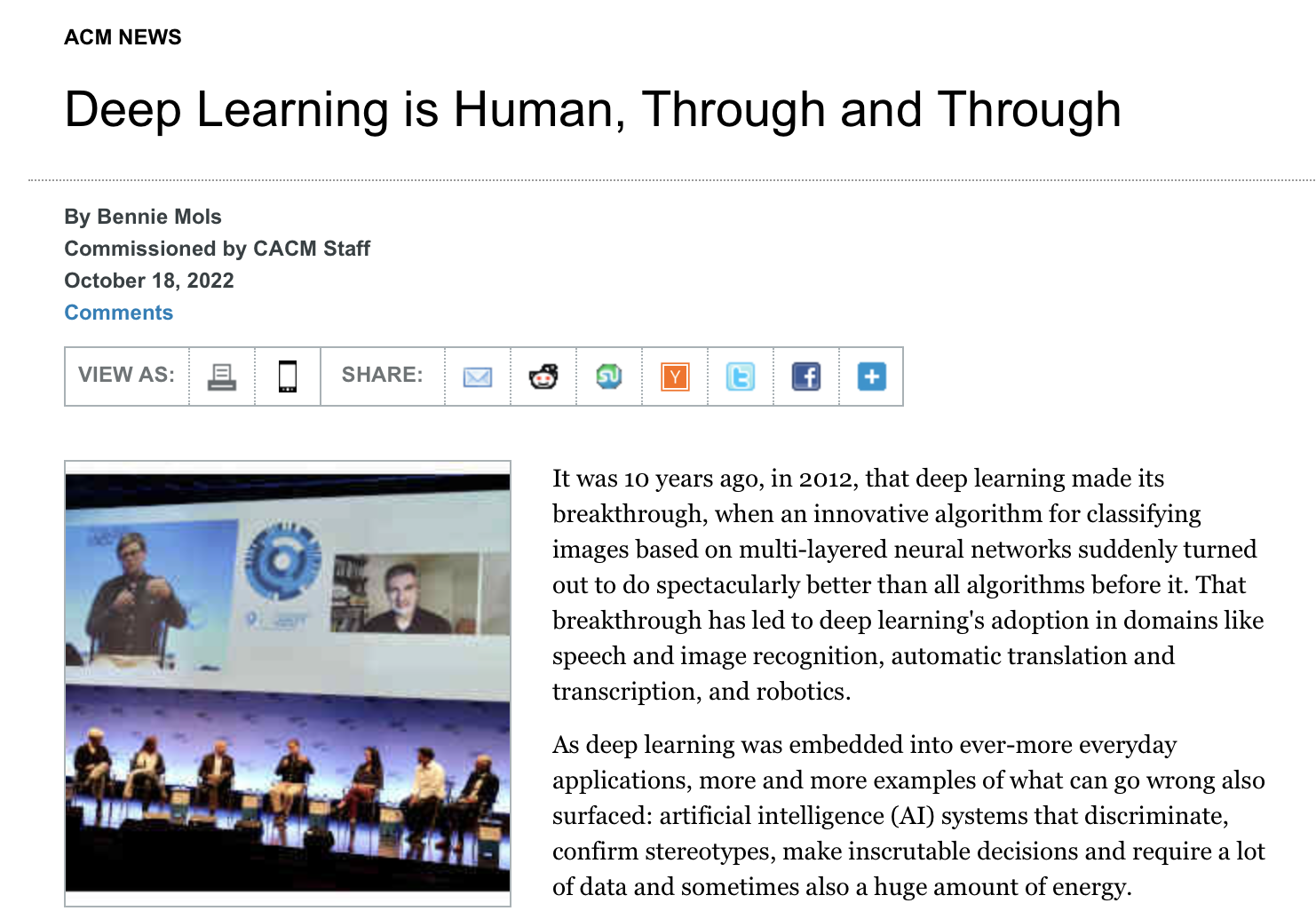
In this context, the 9th Heidelberg Laureate Forum organized a panel discussion on the applications and implications of deep learning for an audience of some 200 young researchers from more than 50 countries. The panel included Turing Award recipients Yoshua Bengio, Yann LeCun, and Raj Reddy, 2011 ACM Prize in Computing recipient Sanjeev Arora, and researchers Shannon Vallor, Been Kim, Dina Machuve, and Shakir Mohamed. Katherine Gorman moderated the discussion.


The full story can be read on the website of the Communications of the ACM

Friday, October 7, 2022

There is Plenty of Room at The Top (of Supercomputing)


Supercomputers are the Olympic champions of scientific computing. Through numerical simulations, they enrich our understanding of the world, be it stars lightyears away in the universe, the Earth's weather and climate, or the functioning of the human body.

For over four decades, Jack Dongarra has been a driving force in the field of high-performance computing. Earlier this year, Dongarra was awarded the 2021 ACM A.M. Turing Award for "his pioneering contributions to numerical algorithms and libraries that enabled high performance computational software to keep pace with exponential hardware improvements for over four decades."

Writer Bennie Mols met with Dongarra during the 9th Heidelberg Laureate Forum in Germany in September to talk about the present and future of high-performance computing. Dongarra, now 72, has been a University Distinguished Professor at the University of Tennessee (U.S.) and a Distinguished Research Staff Member at the U.S. Department of Energy's Oak Ridge National Laboratory since 1989.

Read the rest of my article on the website of the Communications of the ACM