Showing posts with label ACM (Association for Computing Machinery). Show all posts

Monday, December 22, 2025

The path to a superhuman AI mathematician

Wiskunde is waarschijnlijk het eerste domein waarin bewijs van AI-superintelligentie zichtbaar wordt, zegt theoretisch computerwetenschapper Sanjeev Arora. Voor de Communications of the Association for Computing Machinery (ACM) schreef ik over zijn ideeën.

Mathematics is the first place where evidence of AI superintelligence is likely to appear, theoretical computer scientist Sanjeev Arora says. For the Communications of the Association for Computing Machinery (ACM) I wrote about his ideas.


“Will there be a superhuman AI mathematician?” asked theoretical computer scientist professor Sanjeev Arora from Princeton University at the 12th Heidelberg Laureate Forum this September. Well, what would that mean? Imagine the set of all possible math theorems. Only a subset has been proven by human mathematicians. Arora: “A superhuman AI mathematician is one that can prove more theorems than humans have.”

Arora, who won the 2011 ACM Prize in Computing, sketched a possible path to a superhuman AI mathematician. He explained that the idea traces back to David Hilbert’s early 20th-century dream of automating mathematics. That dream was crushed by the work of Gödel, Turing, and Church, yet it left behind something lasting: the concept of formal proof verification — the notion that mathematical proofs can be written in a precise language and then rigorously checked by a computer.

The modern open-source programming language and proof assistant Lean is ideally suited for precisely this purpose, Arora told. A proof written in English can be translated into Lean after which the Lean checker verifies whether or not the proof is correct. Arora: “Rewriting the proof in Lean is presently done by humans, but very soon this will be done by AI.”

The whole article can be read on the ACM website.

Let a Digital Twin Predict Your Heart’s Health

In een artikel voor de Communications of the Association for Computing Machinery (ACM) laat ik zien hoe digitale tweelingen van het cardiovasculaire systeem in de toekomst hartproblemen kunnen voorspellen nog vóórdat je klachten hebt — dankzij simulaties van miljoenen hartslagen en data uit wearables. Prachtig onderzoek van Amanda Randles (Duke University, VS), winnaar van de 2023 ACM Prize in Computing:

In an article for the Communications of the Association for Computing Machinery (ACM), I show how vascular digital twins may soon predict heart problems long before symptoms appear — powered by simulations spanning millions of heartbeats and data from wearables. Beautiful research by Amanda Randles (Duke University, USA), winner of the 2023 ACM Prize in Computing:


At the 12th Heidelberg Laureate Forum this September, Amanda Randles reached a unique milestone: she is the first participant who attended the Forum first as a talented young researcher (in 2013) and returned to give a keynote lecture as a laureate of the ACM Prize in Computing. She won the 2023 prize for her work on “revolutionizing medical diagnostics”. 

Randles, who is now an associate professor of biomedical engineering at Duke University, is developing vascular digital twins: virtual replicas of a patient’s vascular system. They evolve over time with the patient and are partly informed by data from wearable devices. Her long-term vision is that, in the future, these digital twins will be used to predict and prevent disease, beginning with heart attacks.

The whole article can be read on the ACM website.


Tuesday, July 22, 2025

AI in the Era of Climate Change: Solution or Problem?

AI could help save energy but in the near term AI datacenters will use more energy.


This article was written for ACM News and published on 12 May 2025.

With the rise of deep learning since 2010, the number of computations needed to train artificial intelligence (AI) models has doubled about every six months. Enabling that growth requires a lot of energy, and in practice most of that comes from fossil fuels.

On the other hand, there are also countless ways AI can help save energy, which raises the pressing question of whether AI will lead to a net increase or decrease in energy consumption and, subsequently, what effect that will have on climate change.

That question was at the center of the session “AI in the Era of Climate Change: Solution or Problem?” at the AAAS Annual Meeting in Boston in February.

The complete article can be read here.

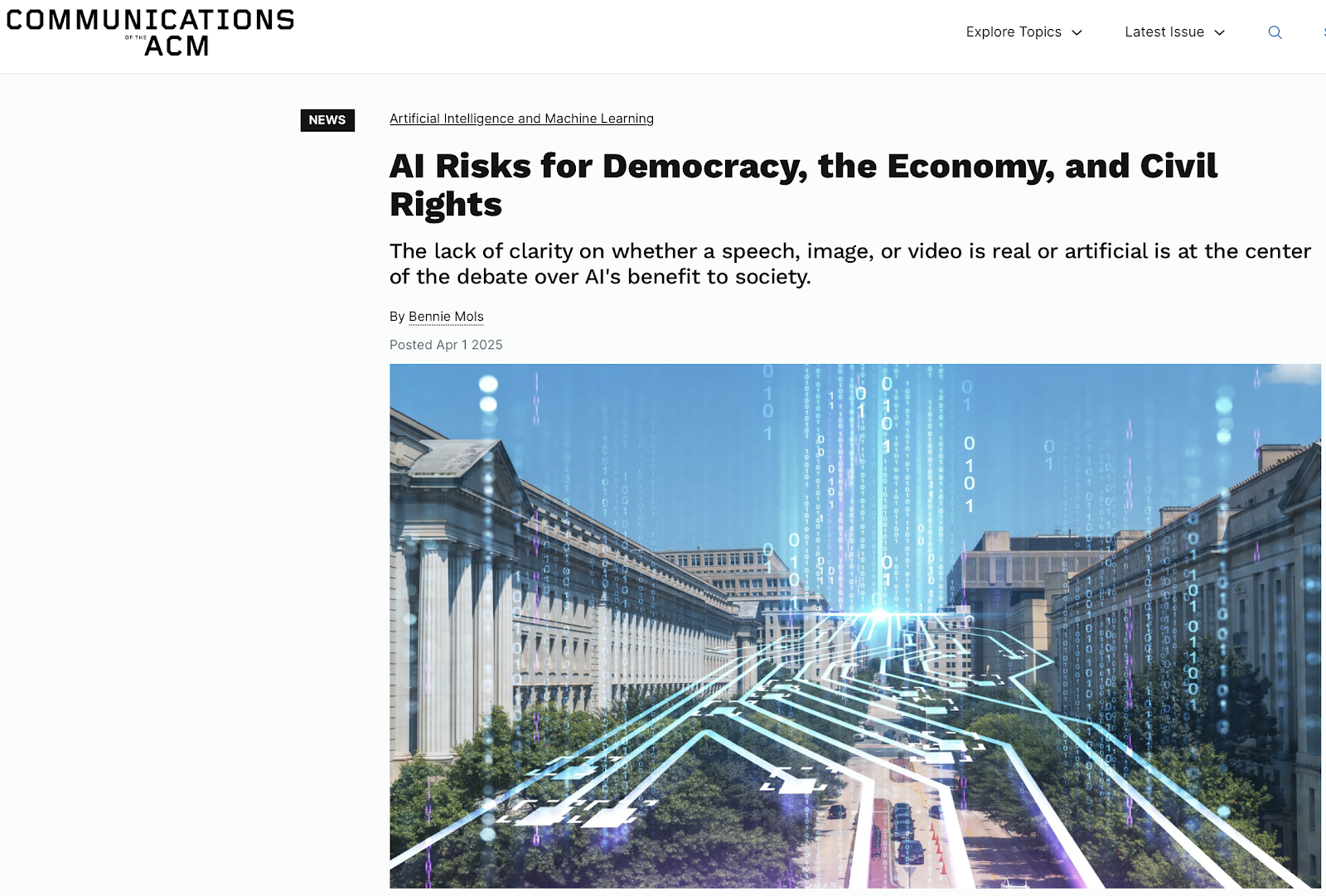
AI Risks for Democracy, the Economy, and Civil Rights

The lack of clarity on whether a speech, image, or video is real or artificial is at the center of the debate over AI's benefit to society.


This article was written for ACM News and published on 1 April 2025.

Since January’s launch of DeepSeek R1, the Chinese open-source variant of OpenAI’s GPT-o1, the metaphor of the ‘AI race’ has dominated the geopolitical discussion about artificial intelligence (AI) technology. The debate on the real impact of AI on society and the best ways for AI to benefit society as a whole has faded into the background.

However, these topics were at the heart of the conference session “Risks from AI to the Economy and Society” at the recent American Association for the Advancement of Science annual meeting in Boston.

The complete article can be read here.

Rethinking Social Media’s Future


Decentralization and open protocols for social technologies get a call for consideration.


This article was written for ACM News and published on 1 May 2025.

It was only 15 to 20 years ago that social media platforms like Facebook, Twitter (now X), YouTube, and Instagram were hailed as drivers of social connections, multipliers of knowledge and experiences, and even as catalysts for better-functioning democracy. In fact, Time magazine chose Facebook co-founder Mark Zuckerberg as its 2010 Person of the Year, “for changing how we all live our lives.”

“Sure, there are lots of benefits of social technologies,” said Sarita Schoenebeck, a professor in the School of Information at the University of Michigan. “They allow people to participate, to enjoy social relations online, to advocate and to learn new things. But now the harms feel very urgent and growing: disinformation, harassment, quality of information, security, mental health. Are social technologies now actually helping society? And if not, what to do about it?”

The complete article can be read here.

How Liquid Networks Make Robots Smarter

Liquid networks can learn to associate cause and effect, which makes them suitable for robots and other real-world applications.


This article was written for ACM News and published on 24 April 2025.

When Daniela Rus and her collaborators looked at how a deep neural network made decisions in the vision system of their laboratory’s self-driving car, they noticed that its attention was focused on the entire image, even the bushes and trees at the side of the road. “But that’s not how people drive,” said Rus in her office in the Massachusetts Institute of Technology (MIT)’s Computer Science and Artificial Intelligence Laboratory (CSAIL), of which she is the director. “We usually look at the road horizon and the sides of the road.”

Traditionally AI and robotics have been largely two separate fields, Rus explained. “AI has been amazing us with its decision-making and reasoning, but it is confined in the digital space. Robots have physical presence but are generally pre-programmed and not intelligent. We are aiming to bridge the separation between AI and robots by developing what I call ‘physical AI’. Physical AI uses AI’s power to understand text, images, and video to make a real-world machine smarter. And those machines can be any physical platform: a sensor, a robot, or a power grid.”

The complete article can be read here.

Monday, May 15, 2023

'Let a Thousand AIs Bloom'

The field of artificial intelligence (AI) has been dominated by the deep learning approach in recent years, and there is some concern that focus may be limiting progress in the field. David Danks, a professor of data science and philosophy at the University of California, San Diego, advocates for more diversity in AI research or, as he puts it, "let a thousand AIs bloom."


This article was written for ACM News and published on 4 May 2023.

What has led you to the conclusion there is too little diversity in the AI field?

We have seen enormous advances in the ability of AI, and in particular deep learning, to predict, classify, and generate what we might think of as the surface features of the world. These successes are marked by two fundamental features that don't always hold: having a measurement of what matters, and being able to define what counts as success. Deep learning can do amazing things, but what worries me is that it crowds everything else out.

Such as…

We have struggled to come up with AI systems that can discover the underlying structure of the world, things that show up in the data but are not defined by them. So one reason that we are struggling with developing more trustworthy and value-centered AI is because trust and values fundamentally are not things that we know how to give numerical expressions for.

Can you give an example?

It is difficult to figure out what counts as success for a self-driving car. Sure, we want to drive safely, but what counts as driving safely is very context-dependent. It depends on social norms, it depends on the weather, it depends on suddenly occurring situations on the road. As soon as there is an unusual context, self-driving cars can't reason their way out like a human driver can.

The complete article can be read here.

Sunday, November 6, 2022

Small Sensors for Big Challenges


I wrote this story for the Communications of the ACM and it was published on 1 November, 2022

Shwetak Patel loves to combine academic research with being an entrepreneur, all in the field of sensing technology and ubiquitous computing. At a press conference during the 9thHeidelberg Laureate Forum this September, he put it this way: "Being an academic is my intellectual playground. Entrepreneurship is a way to show impact. When I was a young researcher, one of my goals was to build something that could impact the lives of a million people. I hit that goal, so now I'm going to go for a billion people."

Patel is the Washington Research Foundation Entrepreneurship Endowed Professor in Computer Science & Engineering, and Electrical and Computer Engineering, at the University of Washington. In 2018, he was awarded the ACM Prize in Computing for his contributions to creative and practical sensing systems for sustainability and health. As a result, he was invited to the Heidelberg Laureate Forum (HLF), an annual conference where 200 young researchers spend a week interacting with laureates of the most important prizes in computer science and mathematics.

The full story can be read on the website of the Communications of the ACM

Tuesday, October 18, 2022

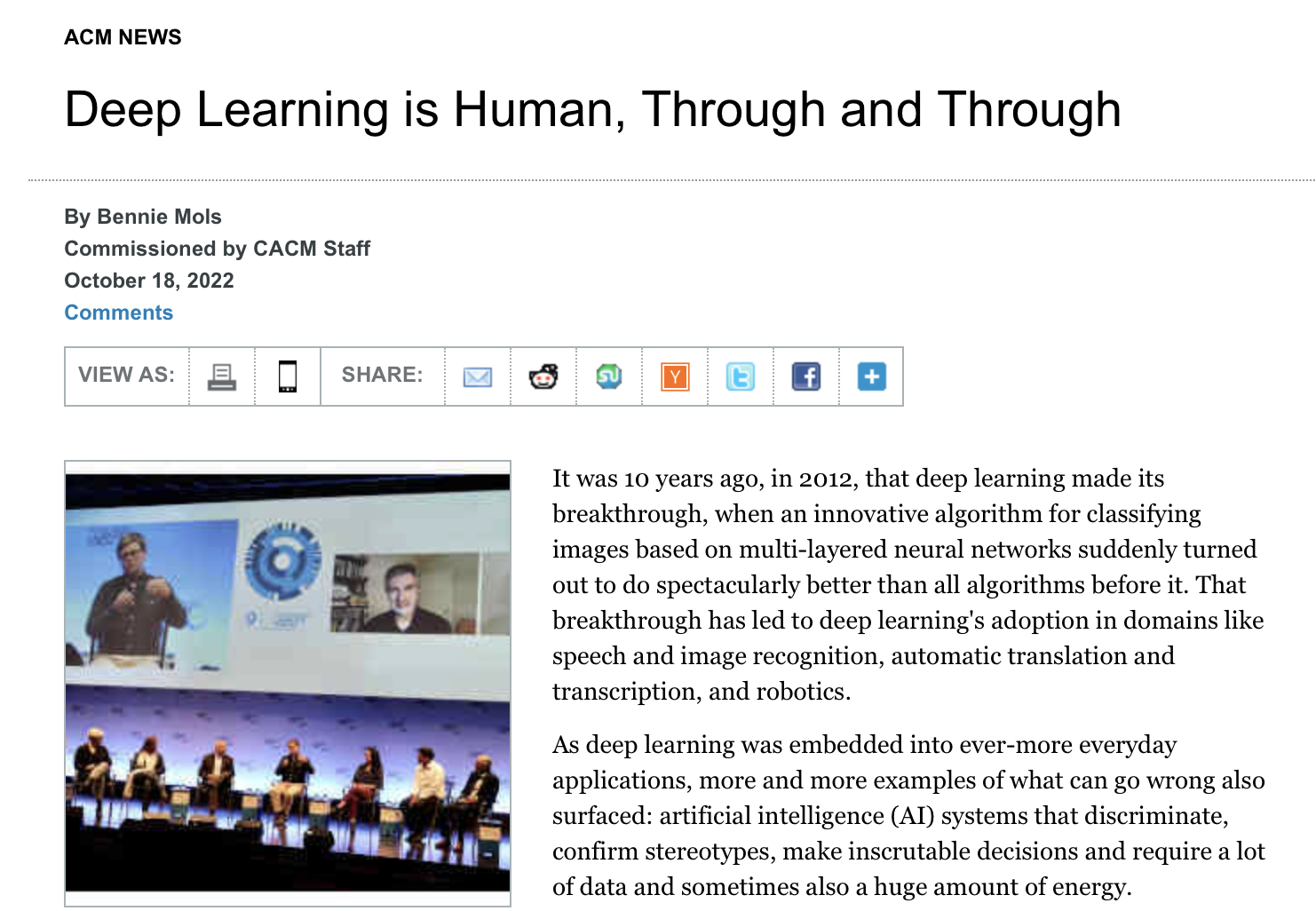
Deep Learning is Human, Through and Through


I wrote this story for the Communications of the ACM and it was published on October 18, 2022

It was 10 years ago, in 2012, that deep learning made its breakthrough, when an innovative algorithm for classifying images based on multi-layered neural networks suddenly turned out to do spectacularly better than all algorithms before it. That breakthrough has led to deep learning's adoption in domains like speech and image recognition, automatic translation and transcription, and robotics.

As deep learning was embedded into ever-more everyday applications, more and more examples of what can go wrong also surfaced: artificial intelligence (AI) systems that discriminate, confirm stereotypes, make inscrutable decisions and require a lot of data and sometimes also a huge amount of energy.

In this context, the 9th Heidelberg Laureate Forum organized a panel discussion on the applications and implications of deep learning for an audience of some 200 young researchers from more than 50 countries. The panel included Turing Award recipients Yoshua Bengio, Yann LeCun, and Raj Reddy, 2011 ACM Prize in Computing recipient Sanjeev Arora, and researchers Shannon Vallor, Been Kim, Dina Machuve, and Shakir Mohamed. Katherine Gorman moderated the discussion.


The full story can be read on the website of the Communications of the ACM

Friday, October 7, 2022

There is Plenty of Room at The Top (of Supercomputing)


Supercomputers are the Olympic champions of scientific computing. Through numerical simulations, they enrich our understanding of the world, be it stars lightyears away in the universe, the Earth's weather and climate, or the functioning of the human body.

For over four decades, Jack Dongarra has been a driving force in the field of high-performance computing. Earlier this year, Dongarra was awarded the 2021 ACM A.M. Turing Award for "his pioneering contributions to numerical algorithms and libraries that enabled high performance computational software to keep pace with exponential hardware improvements for over four decades."

Writer Bennie Mols met with Dongarra during the 9th Heidelberg Laureate Forum in Germany in September to talk about the present and future of high-performance computing. Dongarra, now 72, has been a University Distinguished Professor at the University of Tennessee (U.S.) and a Distinguished Research Staff Member at the U.S. Department of Energy's Oak Ridge National Laboratory since 1989.

Read the rest of my article on the website of the Communications of the ACM

Thursday, October 21, 2021

Can future discoveries be made by artificial intelligence?


This story I wrote for ACM News and was published on October 21, 2021 

'AI disentangles protein folding' was one of the headlines in the selection of breakthroughs achieved during the year 2020 by the magazine Science last December. An artificial intelligence (AI) program called AlphaFold, developed by Alphabet subsidiary DeepMind, had succeeded in making a great leap in one of biology's grand challenges: how to predict the three-dimensional shape of a protein when its amino acid sequence is known.

This breakthrough is likely just the beginning of how AI is going to change scientific discovery.

In that light, it is no coincidence that this year's 8th Heidelberg Laureate Forum (HLF) featured a panel discussion on the question of whether future discoveries can be made by AI. The Heidelberg Laureate Forum is an annual conference, this year organized online because of the pandemic, where 200 young researchers in mathematics and computer science spend a week interacting with laureates of the Abel Prize, the ACM A.M. Turing Award, the ACM Prize in Computing, the Fields Medal, and the Rolf Nevanlinna Prize.

In September, on the last day of this year's HLF, moderator and science journalist Volker Stollorz discussed the topic of using AI for scientific discovery with three scientists: Harry Collins, a professor of Social Science at Cardiff University (U.K.); Jeffrey A. Dean, senior fellow at Google Research (U.S.) and recipient, with Sanjay Ghemawat, of the ACM Prize in Computing for 2012, and Dafna Shahaf, associate professor of data science in the Department of Computer Science and Engineering at Hebrew University of Jerusalem (Israel).

Read the full story on the website of the ACM.

The Outlook for Virtual Meetups


This story I wrote for ACM News and was published on October 14, 2021

How do you cut a birthday cake with your friends if the coronavirus pandemic does not allow you to get close to each other?

That was the challenge that the national research institute for mathematics and computer science in the Netherlands, Centrum Wiskunde & Informatica (CWI), faced with professional cake designer Cake Researcher when CWI celebrated its 75th anniversary earlier this year.

Fortunately, CWI has an in-house specialist who solved that problem using virtual reality (VR): Pablo Cesar, a researcher in human-centered multimedia systems and leader of the Distributed and Interactive Systems group at CWI, who also is a professor and chair of Human-Centered Multimedia Systems at the Netherlands' Delft University of Technology (TU Delft). Cesar, named an ACM Distinguished Member in 2020, investigates how to improve the ways people use interactive systems to communicate with each other.

While we currently use interactive systems to communicate person to person via flat screens, it would be much more convenient for many applications to communicate via three-dimensional (3D) video, also called volumetric video. Ultimately, we might want to transfer high-quality 3D models of people anywhere in the world in real time, something that Microsoft calls holoportation.

Working on the path to holoportation, Cesar develops state-of-the-art technology for capturing and distributing volumetric video. He showed Bennie Mols around in CWI's two VR rooms. Surrounded by Kinect cameras standing on tripods and hanging from the ceiling, Cesar spoke about where the technology stands right now, and what the future holds.

Read the full story on the website of the ACM.

Sunday, September 26, 2021

Using AI to Drill Down in Physics

If a computer can teach itself to play the age-old board game Go better than the human world champion, if a computer can even conjure up a genius new Go move, couldn't a computer also discover new physics?


I wrote this story for ACM News and it was published on July 8, 2021

Jesse Thaler, an associate professor of physics at the Massachusetts Institute of Technology (MIT), investigates the potential of artificial intelligence (AI) in particle physics. In 2020, Thaler also became the director of the National Science Foundation's AI Institute for Artificial Intelligence and Fundamental Interactions (IAIFI), which is dedicated to advancing physics knowledge and galvanizing AI research innovation.

At the moment, the Standard Model of particle physics is the best description of three of the four fundamental forces of nature, and of a large family of elementary particles. Finding deviations from the Standard Model might lead physicists to discover new particles or new interactions, and AI might be able to play an important role in this.

In a Zoom interview, Thaler talks about the present and the future of applying AI to particle physics.

Read the full story on the website of the ACM.


Engineering Additional Creativity

The field of artificial intelligence (AI) has long dreamed about computers that can automatically write humanlike stories. In recent years, with the advent of machine learning, AI researchers have found new opportunities for such automated text writing.


I wrote this story for the Communications of the ACM and it was published on July1, 2021

Last year, Open AI's automatic text generator 
GPT-3 was one of the biggest breakthroughs in AI research. GPT-3 (Generative Pre-trained Transformer 3) writes human texts in all kinds of genres, which is unique. Give a piece of text to the machine, and it generates a new piece of text which the machine considers to be the most likely continuation of the first. This can be an essay, a poem, a song, a dialogue, an interview, or any other text form that can serve as a starter. GPT-3 also can perform very different tasks from just a few examples, as long as they involve text. It can, with only a few examples, translate, generate news articles, complete a short story, correct English grammar, answer factual questions about texts, and even provide answers to simple arithmetic problems.


However, in order to produce interesting results, GPT-3 requires a lot of human intervention. There is nothing wrong with that, says AI researcher Melissa Roemmele; on the contrary, she says, it means humans can use such an AI text generator to augment their own creative writing.

Read the full story on the website of the ACM.

Friday, December 18, 2020

Breakthrough in energy efficient artificial intelligence


This article was written for ACM News 

The human brain processes information in an incredibly energy-efficient way. Its power consumption is only a tiny 20 watt. Computers that mimic the brain’s neural networks via deep learning have given rise to wonderful applications in recent years, but they consume much more energy than the human brain.

Thanks to an algorithmic breakthrough in training spiking neural networks (SNN’s), many applications of artificial intelligence, such as speech recognition, gesture recognition and the classification of electrocardiograms (ECG), can become a factor of a hundred to a thousand more energy-efficient. This means that it will be possible to put much more artificial intelligence (AI) into chips, allowing applications to run on a smartwatch or a smartphone, for example, while until now this had to be done in the cloud.

Moreover, by running AI on a local device, the applications become more robust and privacy friendly. More robust, because there is no longer a need for a network connection to the cloud. And more privacy-friendly, because data can remain local.

The breakthrough was achieved by a research team from Centrum Wiskunde & Informatica (CWI), the Dutch national research center for mathematics and computer science, together with the IMEC/Holst Research Centre from Eindhoven, also in the Netherlands. It was published this July in a reviewed paper at the International Conference on Neuromorphic Systems (https://dl.acm.org/doi/10.1145/3407197.3407225). The algorithm is available as open source (https://github.com/byin- cwi/SRNN- ICONs2020).

Teamleader is CWI researcher and professor of cognitive neurobiology at the University of Amsterdam (UvA) Sander Bohté. ACM Communications talked to Bohté about the research and its applications.

Read the rest of the article on the website of ACM News

Sunday, September 13, 2020

Self-driving vehicles start understanding pedestrians and cyclists

This article was published online by ACM News on August 12, 2020


For a driverless vehicle, it matters a lot whether it is driving around in Phoenix, AZ —where many current large-scale tests take place—or in Amsterdam, capital city of the Netherlands. Compared to Phoenix, the roads in Amsterdam are narrower, might involve bridges over canals, and are generally less structured. The weather in Amsterdam is also unstable and often includes showers, but the biggest difference lies in the traffic composition. In the Dutch capital there are many more cyclists and pedestrians on the streets than in Phoenix, getting up close to the vehicles and not always obeying traffic rules.

In the center of Amsterdam, a self-driving vehicle would have to make decisions constantly: does the pedestrian who is suddenly crossing the road see the vehicle? What is the woman with a child on the back of her bike planning to do? At the Netherlands' Delft University of Technology, Dariu Gavrila is leading the Intelligent Vehicles research group. Gavrila focuses on the interaction between self-driving vehicles and vulnerable road users, such as pedestrians and cyclists. Gavrila received the IEEE ITS Outstanding Research Award 2019 for his long-term work on active vulnerable road user safety.

Read the whole story on the website of ACM News

Thursday, July 30, 2020

The Impact of AI on Organizations

How does the use of artificial intelligence (AI) change organizations in practice? How can organizations improve their application of AI systems?

This article was published online by ACM News on July 28, 2020


In order to find answers to these questions, Marleen Huysman, affiliated with the Vrije Universiteit Amsterdam (VU) in the Netherlands, leads a 35-person multidisciplinary research group called the KIN Center for Digital Innovation. The group includes computer scientists, engineers, sociologists, anthropologists, business experts, and industrial designers.

Their working method is unique: they obtain permission to embed themselves into an organization, then study as digital anthropologists for many months and sometimes years the impact of a recently introduced AI system. To date, they have performed studies of how AI impacts the practices of radiology, predictive policing, robotic surgery, and recruitment.

Bennie Mols interviewed Huysman about the impact AI can have on organizations.

Read the whole article on the website of the ACM.

Friday, June 5, 2020

Giving AI common sense

At the Allen Institute for AI in Seattle, computer scientist Yejin Choi is leading project Mosaic, which aims to teach machines common-sense knowledge and reasoning, one of the hardest and longest-standing challenges in the field of artificial intelligence (AI).

Choi, senior research manager, leads the project, which started in 2018 and recently delivered its first results. Choi is also an associate professor at the Paul G. Allen School of Computer Science & Engineering at the University of Washington in Seattle.

I interviewed Choi at the Allen Institute for AI in Seattle.


Read the full article on the website of the ACM.


Thursday, May 28, 2020

Building a human-AI dream team

Creating a good artificial intelligence (AI) user experience is not easy. Everyone who uses autocorrect while writing knows that while the system usually does a pretty good job of acthing and correcting errors, it sometimes makes bizarre mistakes. The same is true for the autopilot in a Tesla, but unfortunately the stakes are much higher on the road than when sitting behind a computer.

Daniel S. Weld of the University of Washington in Seattle has done a lot of research on human-AI teams. Last year, he and a group of colleagues from Microsoft proposed 18 generally applicable design guidelines for human-AI interaction, which were validated through multiple rounds of evaluation.

I interviewed Weld about the challenges of building a human-AI dream team.


Read the full article on the website of the ACM.

Thursday, June 20, 2019

How Computation is Changing Journalism

This article was published by the Communications of the ACM.


Nicholas Diakopoulos grew up being exposed to journalism, as his father was a journalist. The younger Dikopoulos decided he wanted to study computer science, and completed a Ph.D. in the field at the Georgia Institute of Technology (Georgia Tech). Midway through his doctorate, he started to think about combining journalism and computation into a new field: computational journalism.

Today, Diakopoulos is an assistant professor in communication studies and computer science at Northwestern University; he also serves as director of the university's Computational Journalism Lab.

In his new book Automating the News: How Algorithms Are Rewriting the Media, Diakopoulos explores the new field of computational journalism, which he has been helping to establish since 2007. The book makes clear how algorithms are changing the journalistic production pipeline from information gathering to sense-making, story-telling, and finally news distribution. Artificial intelligence (AI) already is used to personalize article recommendations, summarize articles, mine data in documents, transcribe recorded interviews, automate content production, moderate comments, and to eliminate (but unfortunately, also to produce) fake news.

What should all journalists know about your book?

A lot of journalists who don't understand how artificial intelligence works might feel threatened: 'oh, AI bots are going to write all our stories. We will be out of work'. In my book, I show over and over again that the cognitive labor of journalists is very difficult to completely automate. There are, of course, bits and pieces that can and will be automated, but more important will be the hybridization of AI with journalists. Jobs in journalism will not disappear, but instead will change.

Read the full article on the website of the ACM.